
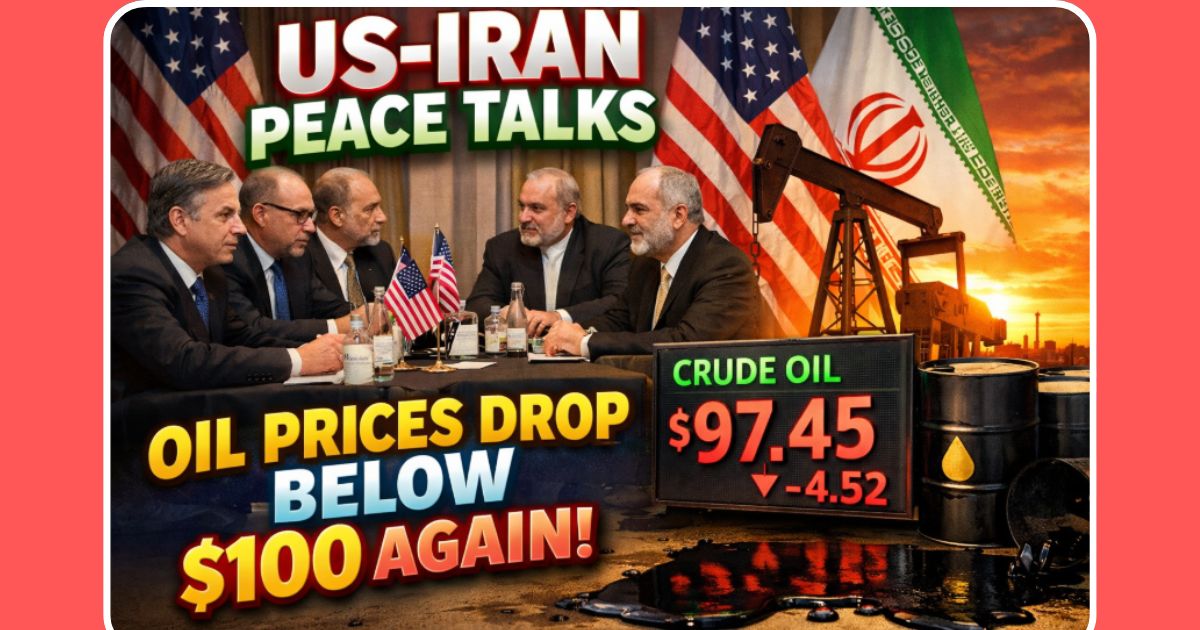
Oil Prices Ease as Renewed US-Iran Talks Calm Markets
Global oil prices pulled back this week as investors reacted to signals that the United States and Iran may return to diplomatic negotiations. After briefly crossing the $100 per barrel mark, crude prices retreated on hopes that tensions in the Middle East could ease.
Energy markets remain highly sensitive to developments in the region, particularly around the Strait of Hormuz, one of the world’s most important oil shipping routes. While uncertainty remains, the possibility of renewed talks has temporarily cooled fears of a prolonged supply disruption.
1. What Happened
Oil prices declined Tuesday following comments from U.S. President Donald Trump indicating that Iran had reached out about restarting negotiations. The remarks came after a weekend breakdown in talks and a U.S. decision to impose a naval blockade targeting Iranian ports.
Brent crude, the global benchmark, fell about 1% to roughly $98 per barrel, while West Texas Intermediate (WTI), the U.S. benchmark, dropped more sharply. Just a day earlier, prices had surged above $100 per barrel after Washington announced measures to restrict Iranian maritime activity.
Reports suggest Iran proposed temporarily limiting uranium enrichment as part of a possible diplomatic compromise. However, U.S. officials reportedly rejected the terms, arguing they were insufficient to address long-term nuclear concerns. Despite the gap between both sides, backchannel communications appear to be ongoing.
Meanwhile, the broader market remains on edge over the Strait of Hormuz. Nearly 20% of the world’s oil and liquefied natural gas shipments typically pass through this narrow waterway connecting the Persian Gulf to global markets. Iranian threats to disrupt traffic there have heightened volatility since late February.
Although oil has retreated from recent highs, prices remain significantly above pre-conflict levels earlier this year, when crude traded closer to $73 per barrel.
2. Why It Matters
Energy prices directly affect inflation, transportation costs, and household budgets in countries such as the United States, Canada, and the United Kingdom. When oil prices spike, gasoline and diesel typically follow within weeks.
In the U.S., higher oil prices can quickly translate into higher prices at the pump, which in turn influences consumer spending and political sentiment. In the UK and parts of Europe, where energy costs were already elevated after previous geopolitical tensions, another sustained rise could put renewed pressure on governments and central banks.
Beyond fuel prices, oil is a key input for manufacturing, aviation, shipping, and agriculture. Elevated crude prices increase operational costs across supply chains, often leading to higher prices for goods and services.
Financial markets also react sharply to oil volatility. Energy stocks may benefit from higher prices, while airlines, logistics companies, and manufacturers face increased expenses. Central banks monitor energy trends closely, as sustained price increases can complicate efforts to manage inflation.
3. Who Is Affected
Consumers
Drivers in North America and Europe are among the most immediately affected. Even a $5–$10 increase per barrel can raise gasoline prices noticeably over time.
Businesses
Industries that rely heavily on fuel—such as airlines, shipping firms, and trucking companies—face rising operational costs. These expenses often pass through to consumers.
Energy producers, however, may see stronger earnings. Major oil companies benefit when crude prices rise, boosting revenue from exploration and trading divisions.
Oil-Importing Countries
Asian economies like Japan and South Korea, which import significant volumes of Gulf energy supplies, are particularly sensitive to disruptions in the Strait of Hormuz. Market indices in Asia rose slightly this week, reflecting optimism that tensions might ease.
Policy Makers
Governments in the U.S., Canada, and Europe are closely monitoring the situation. Sustained oil price increases could influence monetary policy decisions, fiscal planning, and energy security strategies.
4. What Happens Next
The direction of oil prices now depends largely on diplomatic progress and shipping conditions in the Persian Gulf.
If negotiations resume formally and lead to a temporary de-escalation, oil could stabilize below $100 per barrel. Traders are watching closely for signs that Iran may pause aspects of its nuclear program or that the U.S. might soften certain enforcement measures.
However, if tensions escalate—particularly if shipping traffic through the Strait of Hormuz remains restricted—prices could rise sharply again. Energy analysts note that even the perception of risk in the region can push futures contracts higher.
The International Energy Agency (IEA), which coordinates emergency oil stock releases among industrialized nations, has already authorized a large release of strategic reserves earlier this year. Officials have signaled they could act again if disruptions worsen.
Meanwhile, energy markets are assessing how long current supply interruptions might last. Cargoes loaded before the latest escalation are still reaching global markets, but if shipments decline in the coming weeks, tighter supply conditions could emerge.
5. Expert and Policy Insight
Energy economists caution that markets may be underestimating the long-term risk. While recent price declines suggest optimism, the structural vulnerability of global oil supply remains.
The head of the International Energy Agency emphasized that stockpile releases are only a temporary solution. Strategic reserves can stabilize markets in the short term but cannot replace sustained production and shipping flows indefinitely.
Energy analysts in Australia and Europe have also noted that traders may be adjusting positions after a rapid surge earlier in the week. Such short-term corrections are common in volatile commodity markets.
In Washington, officials from the Department of Energy have indicated that oil prices could remain elevated until shipping through the Strait of Hormuz returns to normal. That timeline remains uncertain.
The broader geopolitical picture also matters. Middle East tensions have historically led to energy shocks that ripple across global markets. While diplomatic engagement may reduce immediate risks, a durable agreement would require sustained cooperation and verification.
6. FAQ
1. Why did oil prices fall after crossing $100 per barrel?
Prices declined after indications that the U.S. and Iran may resume peace talks. Traders reacted to signs of possible de-escalation.
2. How important is the Strait of Hormuz to global energy?
It is one of the world’s most critical oil transit routes. Around one-fifth of global oil shipments pass through it.
3. Could gasoline prices rise in the U.S. and UK?
Yes. If crude prices remain elevated or increase further, fuel prices could rise in the coming weeks.
4. What role does the International Energy Agency play?
The IEA coordinates emergency oil reserve releases among member countries to stabilize markets during supply disruptions.
5. Is a full peace agreement likely soon?
Negotiations appear possible, but major differences remain. Markets are responding to early signals rather than confirmed agreements.
Conclusion
Oil markets are navigating a delicate balance between geopolitical risk and diplomatic opportunity. While renewed communication between Washington and Tehran has helped ease immediate fears, uncertainty remains high.
For consumers and businesses across the U.S., UK, and Canada, the coming weeks will be critical. If shipping through the Strait of Hormuz stabilizes and negotiations progress, prices could remain manageable. If tensions intensify, another sharp spike in oil could follow.
Energy markets will continue to respond swiftly to every development, underscoring how closely global stability and economic confidence are tied to events in the Middle East.

- ఏపీలో స్థానిక ఎన్నికల షెడ్యూల్: మున్సిపల్, ఎంపీటీసీ, పంచాయతీ ఎన్నికలు ఎప్పుడంటే? - అక్టోబర్ 14, 2026
- AP Pension Status by Aadhaar: ఆధార్తో పెన్షన్ స్టేటస్ ఇలా చెక్ చేయండి - అక్టోబర్ 6, 2026
- 5 Lakh Women Entrepreneurs: మహిళలకు సీఎం చంద్రబాబు బంపర్ ప్లాన్.. ‘స్వయం ఏపీ’తో ప్రపంచ మార్కెట్లకు! - అక్టోబర్ 5, 2026


