
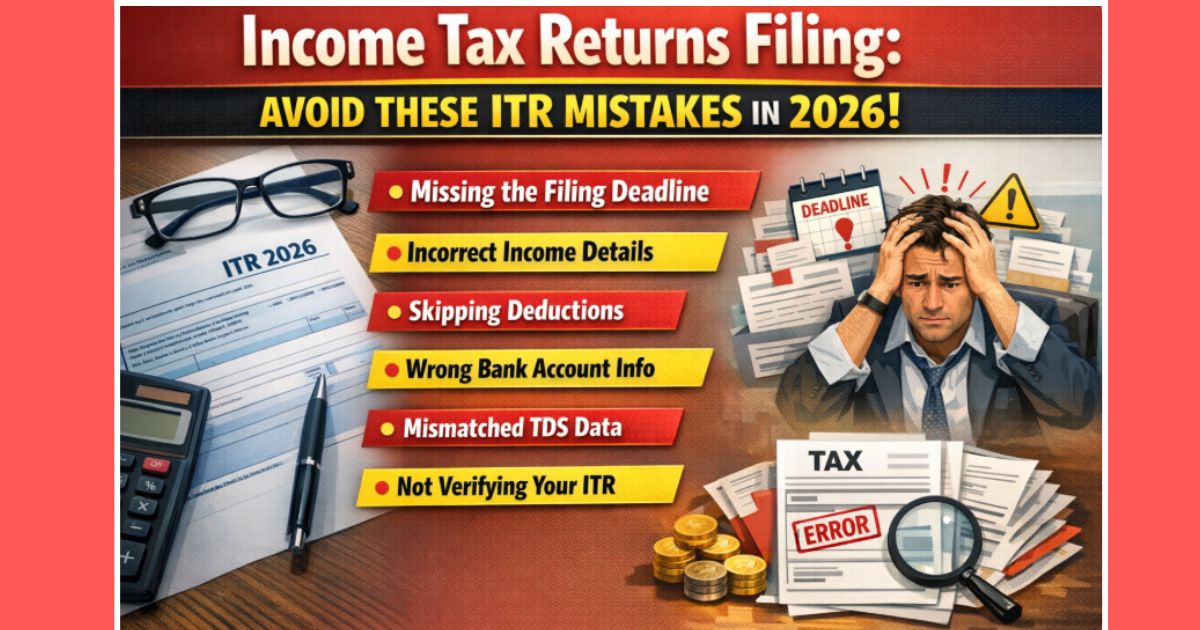
Income Tax Returns Filing: Avoid These ITR Mistakes in 2026
Filing Income Tax Returns (ITR) has become simpler with online submission. However, many taxpayers still make common errors that can result in delayed refunds, penalties, or income tax notices.
If you are preparing to file your Income Tax Returns for FY 2025-26 (AY 2026-27), it is important to avoid these mistakes and ensure smooth processing.
Taxpayers can file returns from July 1, 2026, and those opting for ITR-3 or ITR-4 may get extended deadlines until August 31, 2026 (as per eligibility).
Let’s look at the key mistakes you must avoid while filing your ITR.
Choosing the Wrong ITR Form
Selecting the correct ITR form is the first and most important step.
ITR-1
- For salaried individuals
- Income from one house property
- Income from other sources (like interest)
ITR-2
- For individuals or HUFs
- No income from business or profession
ITR-3
For individuals or HUFs having income from a business or profession
ITR-4
For presumptive income from a business or profession
Choosing the wrong form can lead to rejection or tax complications.
Not Verifying the ITR After Filing
After e-filing, your return must be verified. Without verification, the return is considered invalid.
You can verify through:
- Net banking
- Aadhaar OTP
- Electronic Verification Code (EVC)
Incorrect Personal Details
Ensure that:
- Name matches PAN records
- Correct PAN number is entered
- Address, email, and mobile number are accurate
- Date of birth is in DD/MM/YYYY format
- Correct Assessment Year (AY 2026-27) is selected
Mistakes in these details may delay refunds or lead to double taxation issues.
Selecting the Wrong Tax Regime
Taxpayers must carefully choose between:
- Old Tax Regime (with deductions)
- New Tax Regime (lower rates, limited deductions)
- Choosing the wrong regime may result in higher tax liability.
Not Declaring All Income Sources
All income must be reported, including:
- Salary income
- Savings account interest
- Fixed deposit interest
- Rental income
- Capital gains
- Freelance or side income
Even if certain income is exempt, it must still be declared.
Mismatch With Form 26AS and AIS
Before filing, compare your income details with:
- Form 26AS
- Annual Information Statement (AIS)
- TDS (Tax Deducted at Source)
- TCS (Tax Collected at Source)
- Advance Tax payments
If mismatches are found, you may receive a tax notice or face refund delays.
Ignoring Form 16 (For Salaried Employees)
If you worked with more than one employer in a financial year, collect Form 16 from each employer and include all salary income properly.
Missing Advance Tax Payment
If your total tax liability exceeds ₹10,000 in a financial year, you must pay advance tax in installments. Failure may attract interest under Sections 234B and 234C.
Forgetting to Claim Capital Gains Exemptions
Taxpayers often reinvest capital gains but forget to claim exemptions under:
- Section 54
- Section 54EC
- Section 54F
This leads to unnecessary tax payments.
Important ITR Filing Timeline (FY 2025-26)
| Category | Expected Deadline |
|---|---|
| Salaried Individuals | July 31, 2026 |
| Business (ITR-3/4) | August 31, 2026 (if extended) |
(Check official updates before filing.)
Frequently Asked Questions (FAQ)
1. What happens if I choose the wrong ITR form?
Your return may be considered defective, and you may have to file a revised return.
2. Is ITR verification mandatory?
Yes. Without verification, your ITR will be treated as invalid.
3. Can I revise my ITR after filing?
Yes, you can file a revised return before the prescribed deadline.
4. What causes income tax refund delays?
Common reasons include a mismatch in AIS/26AS, incorrect bank details, or failure to verify ITR.
5. Is it compulsory to declare exempt income?
Yes, exempt income must also be disclosed in the ITR.
Conclusion
Filing Income Tax Returns correctly is crucial to avoid penalties, tax notices, and refund delays. By selecting the right ITR form, verifying details, matching AIS data, and declaring all income sources accurately, taxpayers can ensure smooth processing.
Before submitting your return for FY 2025-26 (AY 2026-27), double-check every detail carefully. A small mistake today can lead to bigger tax issues later.

- School Dussehra Holidays 2026: 13 రోజులు సెలవులు.. తేదీలివే - సెప్టెంబర్ 17, 2026
- నిమజ్జనం బంద్.. ఖైరతాబాద్ వినాయకుడి పరిస్థితి ఏంటి? అసలు కారణం ఇదే! - సెప్టెంబర్ 16, 2026
- India Post GDS 2026 Recruitment: టెన్త్తో 23,757 ఉద్యోగాలు.. అప్లై చేశారా? - సెప్టెంబర్ 13, 2026


