
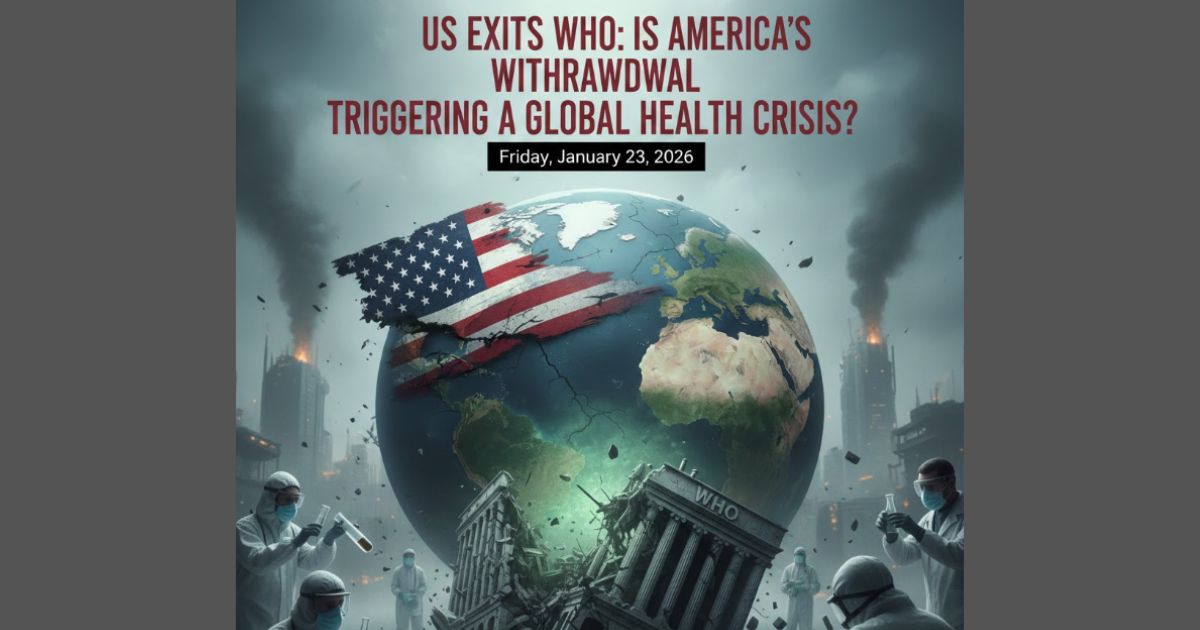
US Exits WHO: Is America’s Withdrawal Triggering a Global Health Crisis?
US withdrawal from WHO: The United States has officially withdrawn from the World Health Organization (WHO), marking one of the most controversial global health decisions in recent years. The move, ordered by President Donald Trump on his first day back in office in January 2025, has sparked intense debate across political and public health circles worldwide.
The US government stated that its decision reflects what it calls the WHO’s failure in handling the COVID-19 pandemic. According to a joint statement from the US Departments of Health and State, Washington will now engage with the WHO only in a limited capacity while completing the formal withdrawal process.
Despite repeated warnings from global health experts, the Trump administration has shown no intention of reversing course. Senior US health officials have clearly stated that America has no plans to rejoin the organization or even participate as an observer.
Instead, the US says it will work directly with individual countries on disease surveillance, outbreak response, and public health cooperation, bypassing international bodies like the WHO.
Financial and Legal Fallout
Under US law, the country must provide one year’s notice before leaving the WHO and clear approximately $260 million in outstanding dues. However, US officials argue that current legislation does not explicitly require payment before withdrawal.
Meanwhile, the US government has suspended all future funding transfers to the WHO. President Trump has used executive authority to halt financial support, claiming the organization has cost the US trillions of dollars over time.
Reports from Geneva further intensified the symbolism of the decision, with witnesses stating that the American flag was removed from outside the WHO headquarters shortly after the announcement.
Impact on the United Nations
The WHO exit is not an isolated move. In recent years, the US has distanced itself from multiple UN bodies, raising concerns that Trump’s newly proposed “peace council” could weaken the broader United Nations system.
Analysts fear that America’s reduced participation in global institutions may undermine international cooperation on health, climate, and security.
How Will This Affect the WHO?
The US withdrawal has pushed the WHO into a severe financial crisis. As its largest donor, the United States previously contributed around 18% of the agency’s total funding.
As a result:
- WHO has cut its senior management team by half
- Agency-wide budgets have been slashed
- Several health programs have been scaled back
- Nearly 25% of staff are expected to be laid off by mid-year
Global health experts warn that reduced funding could weaken pandemic preparedness, disease surveillance, vaccination programs, and emergency response systems worldwide.
Global Health Risks Ahead
Experts say the impact of America’s exit will be felt far beyond the WHO headquarters. Reduced coordination during future outbreaks could increase risks for both developing and developed nations — including the US itself.
With global health threats becoming more frequent and complex, critics argue that withdrawing from international cooperation may leave the world more vulnerable, not safer.
Frequently Asked Questions (FAQ)
Why did the US withdraw from the WHO?
The US cited dissatisfaction with the WHO’s handling of the COVID-19 pandemic and governance issues as the primary reasons.
Will the US rejoin the WHO in the future?
According to senior officials, the US has no plans to rejoin or even participate as an observer.
How much funding did the US provide to the WHO?
The US contributed about 18% of the WHO’s total funding, making it the organization’s largest donor.
What happens to WHO after the US exit?
WHO is facing budget cuts, staff layoffs, and reduced global health operations due to the funding shortfall.
Could this decision affect global health security?
Yes. Experts warn that weakened international coordination could increase risks during future pandemics.
Conclusion
America’s withdrawal from the World Health Organization is more than a political statement — it represents a major shift in global health governance. While the US believes direct bilateral cooperation will be more effective, critics argue that abandoning multilateral institutions could weaken the world’s ability to respond to future health crises.
As the WHO struggles to adapt financially and operationally, the long-term consequences of this decision may reshape global public health for years to come.

- Indian Navy Agniveer SSR Jobs 2026: Inter Passed Can Apply, Salary ₹30,000 - March 12, 2026
- Hair Loss in Women: Hidden Diseases Behind Excessive Hair Fall - March 12, 2026
- Zero Investment Business Ideas: Earn Up to ₹2 Lakh Per Month from Home - March 12, 2026


