
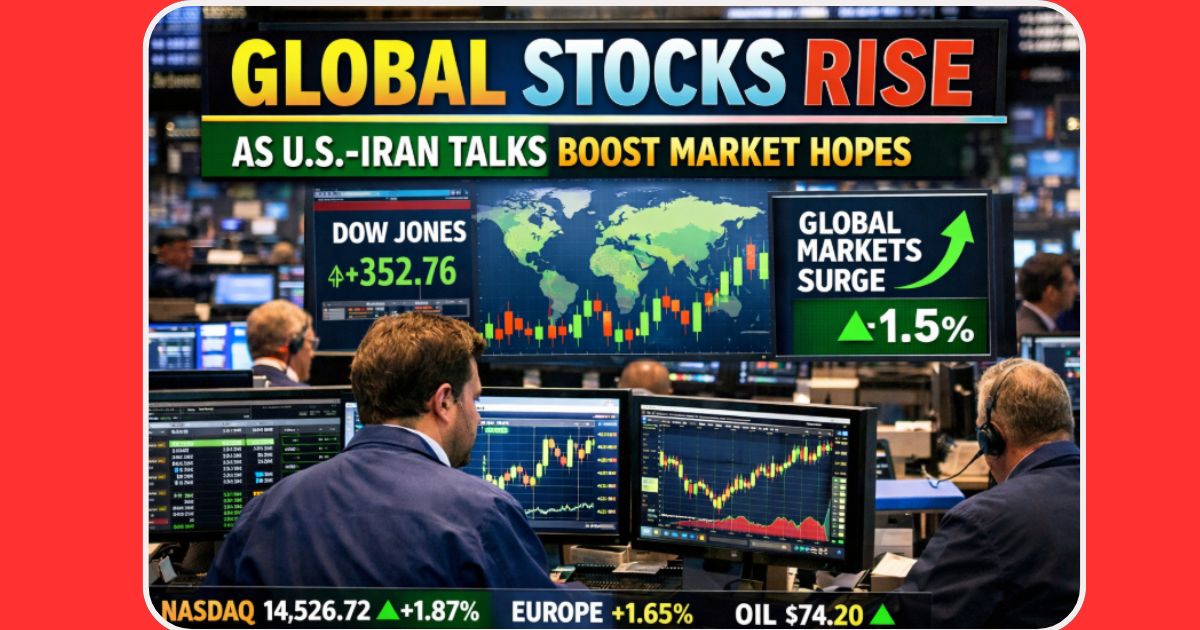
Global Stocks Rally Ahead of U.S.-Iran Talks as Oil Prices Edge Higher
Global financial markets moved higher on Friday as investors looked ahead to crucial diplomatic talks between the United States and Iran. Hopes that tensions in the Middle East could ease helped push stock indexes up across Europe and Asia, even as oil prices remained volatile due to ongoing disruptions in the Strait of Hormuz.
The coming weekend negotiations are widely seen as a potential turning point in a conflict that has shaken energy markets and fueled uncertainty across the global economy.
1. What Happened
Stock markets across Europe and Asia posted gains as traders responded positively to signs that diplomatic efforts may reduce hostilities in the Middle East.
European equities opened higher, with healthcare and technology shares leading the advance. The pan-European benchmark index rose modestly, marking its third consecutive weekly gain. Meanwhile, Asia-Pacific stocks outside Japan surged sharply, recording their strongest weekly performance in more than three years.
Wall Street futures were largely flat after a strong run earlier in the week. The S&P 500 recently extended its winning streak, signaling that investors are regaining confidence after weeks of geopolitical uncertainty.
The rally was fueled by reports that Israel is seeking dialogue with Lebanon, a move that could reduce regional tensions. At the same time, delegations from Tehran and Washington are scheduled to meet in Pakistan for high-level discussions aimed at stabilizing the situation.
However, oil markets remained cautious. Brent crude rose nearly 2% on Friday but is still on track for a significant weekly loss. Oil prices have swung sharply in recent weeks due to disruptions in the Strait of Hormuz, a critical shipping route for global energy supplies.
Shipping traffic through the strait remains severely restricted, operating at well below normal levels. The waterway typically handles about 20% of the world’s oil shipments, making it one of the most strategically important routes in global trade.
Currency markets also reflected shifting investor sentiment. The U.S. dollar is heading for its worst weekly performance since January, while the euro has strengthened, crossing above a key technical benchmark for the first time in over a month.
Investors are also awaiting fresh U.S. inflation data, which could provide clues about how rising energy prices are affecting the American economy.
2. Why It Matters
The current situation highlights how closely financial markets are tied to geopolitical stability—especially when energy supplies are involved.
The Strait of Hormuz is a narrow passage connecting the Persian Gulf to global shipping lanes. A prolonged disruption there can push oil prices higher, raise transportation costs, and contribute to inflation worldwide.
For U.S., UK, and Canadian consumers, higher oil prices often translate into more expensive gasoline, rising heating costs, and increased prices for goods transported by sea. Even small disruptions in global oil supply can have ripple effects across multiple industries.
The recent six-week conflict has already caused energy price spikes and increased volatility in equity markets. While oil has pulled back from its recent highs, it remains sensitive to headlines surrounding diplomatic progress—or setbacks.
Financial markets tend to respond quickly to signs of de-escalation. If investors believe tensions will ease, risk appetite increases. That means higher stock prices and lower volatility.
However, if talks collapse or the Strait of Hormuz remains restricted, markets could quickly reverse course.
3. Who Is Affected
Consumers
Households in North America and Europe are directly affected by oil price swings. Fuel prices impact daily commuting costs, airline ticket prices, and shipping expenses that influence retail prices.
Investors
Equity markets, bond yields, and currency values all respond to geopolitical risk. Investors with exposure to energy stocks, global index funds, or emerging markets may see heightened volatility.
Energy companies may benefit from higher oil prices, but broader market uncertainty can offset gains in other sectors.
Businesses
Companies that rely heavily on global shipping—such as manufacturers and retailers—face higher costs when energy prices rise or when shipping lanes are disrupted.
Technology and healthcare stocks have recently outperformed, suggesting investors are rotating into sectors viewed as more stable during geopolitical tensions.
Governments and Central Banks
Policymakers are closely monitoring how energy prices affect inflation. In the U.S., Federal Reserve officials are watching for signs that rising oil costs could push inflation higher again after months of gradual cooling.
In Europe, bond markets have shown mixed signals, with yields fluctuating as investors balance inflation risks against economic growth concerns.
4. What Happens Next
The immediate focus is on the upcoming talks between U.S. and Iranian representatives.
If negotiations result in progress toward reopening the Strait of Hormuz and reducing hostilities, markets could extend their gains next week. Oil prices may stabilize or fall further if supply concerns ease.
On the other hand, any breakdown in talks could quickly renew volatility. Energy markets remain fragile, and shipping volumes through the strait are still far below normal levels.
Investors will also watch U.S. inflation data and employment figures for signs of how the conflict is affecting the broader economy. Recent jobless claims data suggest the U.S. labor market remains relatively stable, but inflation pressures could complicate monetary policy decisions.
Currency markets may continue adjusting as traders reassess risk. The dollar’s recent weakness indicates some investors are shifting into alternative assets amid geopolitical uncertainty.
5. Expert and Policy Insight
Market strategists suggest that investors are beginning to price in the possibility that the conflict may be nearing a turning point.
If diplomatic progress holds, markets may return focus to underlying economic fundamentals such as corporate earnings, consumer spending, and interest rate expectations.
However, energy analysts caution that even temporary disruptions in the Strait of Hormuz can have outsized effects. The waterway is too important to global oil supply for markets to ignore.
Policy experts also note that any agreement involving the reopening of shipping lanes would likely include security guarantees and monitoring mechanisms to prevent future disruptions.
Central banks face a delicate balance. Rising energy costs can drive inflation, but tightening monetary policy too aggressively could slow economic growth.
For now, markets appear cautiously optimistic—but remain sensitive to developments over the weekend.
6. FAQ
1. Why are global stock markets rising?
Investors are hopeful that upcoming U.S.-Iran talks could reduce tensions in the Middle East, lowering the risk of prolonged energy disruptions.
2. Why is the Strait of Hormuz important?
It is a key shipping route for about one-fifth of the world’s oil supply. Any closure can significantly impact global energy prices.
3. How do higher oil prices affect consumers?
Higher oil prices can lead to more expensive gasoline, airline tickets, heating costs, and shipping-related price increases for goods.
4. What are investors watching next?
Markets are focused on the outcome of diplomatic talks, U.S. inflation data, and any updates on shipping activity in the Strait of Hormuz.
5. Could markets fall again?
Yes. If negotiations fail or tensions escalate, stock markets and oil prices could become volatile once more.
Conclusion
Global markets are entering a critical weekend. While optimism is building, much depends on diplomatic progress and the reopening of vital energy routes. Investors, policymakers, and consumers alike will be watching closely.

- Global Stocks Rally Ahead of U.S.-Iran Talks as Oil Prices Edge Higher - April 10, 2026
- US Officials Alert Major Banks to Cybersecurity Risks from Anthropic’s New AI Model - April 10, 2026
- Trump vs. Obama on Iran: Will the New Deal Be Different? - April 10, 2026


