
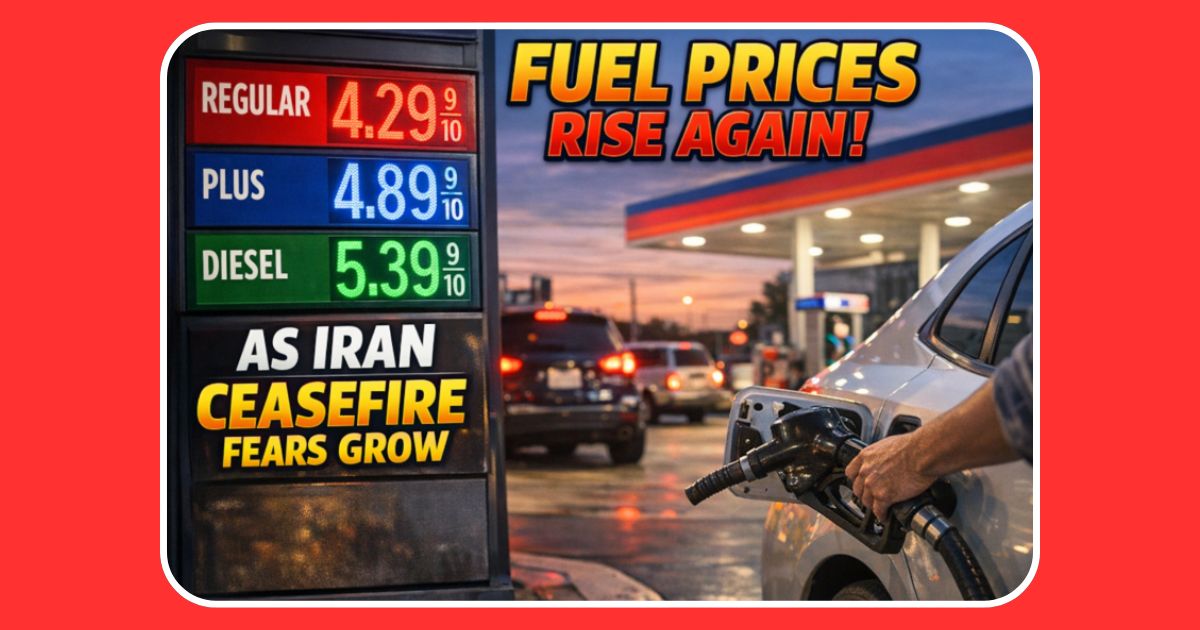
Fuel Prices Rise Again as Iran Ceasefire Fears Grow
Global fuel prices are climbing once more as uncertainty surrounds a fragile ceasefire between the United States and Iran. Although oil markets briefly calmed after an agreement to pause hostilities, renewed tensions in the Middle East have raised fresh concerns about energy supply disruptions — and drivers in the U.S., U.K., and Canada are already feeling the impact.
The central issue remains the Strait of Hormuz, one of the world’s most critical shipping lanes for oil and natural gas. With threats of restricted access and ongoing military tensions, markets are responding cautiously, pushing crude prices higher and delaying hopes of relief at the pump.
1. What Happened
Oil prices initially fell after Washington and Tehran agreed to suspend direct conflict. Investors interpreted the pause as a sign that regional tensions might cool, potentially stabilizing energy supplies.
However, those gains reversed when new military activity was reported involving Israeli strikes in Lebanon. Iranian officials warned of retaliation if such actions continue. U.S. leadership stated that American forces would remain in the region until Iran complies fully with what it calls a “real” ceasefire framework.
At the center of the economic fallout is the Strait of Hormuz. Roughly one-fifth of the world’s oil supply passes through this narrow waterway connecting the Persian Gulf to global markets. One of the ceasefire conditions included safe maritime passage through the strait. But reports that Iran may restrict access due to ongoing tensions have renewed fears of supply bottlenecks.
As a result, Brent crude — the international oil benchmark — surged more than 3.5% in a single day, rising above $98 per barrel. Since fighting began in late February, wholesale oil prices have increased by approximately 35%.
Because crude oil is the primary raw material used to produce gasoline and diesel, pump prices typically follow global oil movements, though often with a delay.
In the United Kingdom, average petrol prices have reached around 158 pence per liter, while diesel is over 191 pence per liter. In the United States, gasoline prices vary by state but have ticked upward in recent days, particularly on the West Coast. Canadian motorists are also seeing higher costs, especially in provinces that rely heavily on imported refined fuel.
2. Why It Matters
Energy prices play a crucial role in everyday life and the broader economy. When oil prices rise sharply, transportation, shipping, manufacturing, and food distribution costs often increase as well. This can contribute to inflation — something many households are already struggling with.
For consumers, higher gasoline and diesel prices mean more expensive commutes, increased travel costs, and potentially higher prices for goods and services.
For financial markets, the uncertainty surrounding the Strait of Hormuz adds another layer of risk. Stock markets in Asia, Europe, and North America gave back some earlier gains as investors reassessed geopolitical risks. Major indices in Japan, Germany, France, and the U.K. closed lower, while U.S. markets showed limited movement amid investor caution.
Investors are particularly sensitive to the possibility of a prolonged disruption in oil shipments. Even if the ceasefire technically remains in place, restricted maritime access could tighten global supply and keep energy prices elevated.
3. Who Is Affected
Drivers and Households:
Motorists are the most visible group affected. In the U.K., a full tank of petrol now costs nearly £14 more than it did before the conflict escalated. Diesel drivers are paying even more. In North America, drivers are seeing modest but noticeable increases, especially in regions dependent on imported crude or refined products.
Shipping and Trade Companies:
Maritime firms are navigating a highly unpredictable situation. Only a small number of vessels have passed through the Strait of Hormuz since the ceasefire announcement — far below normal traffic levels of around 130 ships per day prior to the conflict.
Clearing the backlog could take at least 10 days even if shipping resumes fully. Industry analysts warn that weeks may be needed to move delayed oil and gas cargo, while months could pass before trade returns to pre-crisis stability.
Energy Markets and Investors:
Energy traders are pricing in uncertainty. Even rumors of shipping restrictions can trigger price swings. Investment firms report that markets are “nervous,” reflecting concerns about whether the strait will remain reliably open.
Governments and Policymakers:
Countries heavily dependent on Middle Eastern oil imports — including many in Europe and Asia — are closely monitoring developments. Some governments have negotiated safe passage arrangements for their vessels to minimize disruption.
4. What Happens Next
Fuel prices typically lag behind wholesale oil prices by about 10 to 14 days. That means drivers may not immediately see relief even if crude prices fall again.
If the ceasefire holds and shipping through the Strait of Hormuz stabilizes, pump prices could level off and gradually decline within the next few weeks. However, if tensions escalate or access to the strait is formally restricted, crude prices could climb further — potentially pushing gasoline prices back toward recent highs.
Energy analysts say much depends on whether Iran and the United States maintain diplomatic channels and whether regional conflict expands.
In the best-case scenario, markets could stabilize by late spring. In a worst-case scenario involving prolonged maritime restrictions, global energy prices could remain elevated for several months.
5. Expert and Policy Insight
Energy economists emphasize that geopolitical risk premiums are often temporary but can be powerful. When conflict threatens key supply routes, traders build in extra cost buffers to account for uncertainty.
Policy experts note that Western countries have strategic petroleum reserves that can be used to soften supply shocks. However, releasing reserves is typically seen as a short-term solution and may not fully offset prolonged disruptions.
There is also growing discussion in the U.S., U.K., and Canada about accelerating domestic energy production and renewable energy investments to reduce reliance on volatile regions.
Shipping executives warn that even if military tensions ease, confidence among insurers and freight companies may take time to return. Insurance premiums for vessels traveling through high-risk zones have already increased, adding another layer of cost that could eventually be passed on to consumers.
6. Frequently Asked Questions (FAQ)
1. Why are petrol and diesel prices rising again?
Prices are increasing due to higher global oil costs, which have risen amid uncertainty over the US-Iran ceasefire and shipping risks in the Strait of Hormuz.
2. What is the Strait of Hormuz and why is it important?
It is a narrow waterway between the Persian Gulf and the Gulf of Oman. About 20% of the world’s oil supply passes through it, making it one of the most critical energy transit routes globally.
3. Will fuel prices go down soon?
They could stabilize or decline within two weeks if oil prices fall and the ceasefire holds. However, continued tensions could keep prices elevated.
4. How much have oil prices increased since the conflict began?
Wholesale oil prices have risen by roughly 35% since late February, contributing to higher fuel costs.
5. Could governments step in to lower prices?
Governments may release strategic reserves or adjust fuel taxes, but such measures usually provide temporary relief rather than a long-term solution.
Conclusion
For now, global energy markets remain in a holding pattern. The ceasefire between the United States and Iran has prevented immediate escalation, but doubts about its durability continue to influence oil prices. Until shipping through the Strait of Hormuz fully stabilizes and diplomatic clarity emerges, drivers in the U.S., U.K., and Canada should expect fuel prices to remain sensitive to every headline from the region.

- Fuel Prices Rise Again as Iran Ceasefire Fears Grow - April 9, 2026
- Bigger Tax Refunds Are Arriving — Here’s How to Use Yours Wisely - April 9, 2026
- Taapsee Pannu’s Powerful Legal Drama ‘Assi’ Heads to OTT - April 8, 2026


