
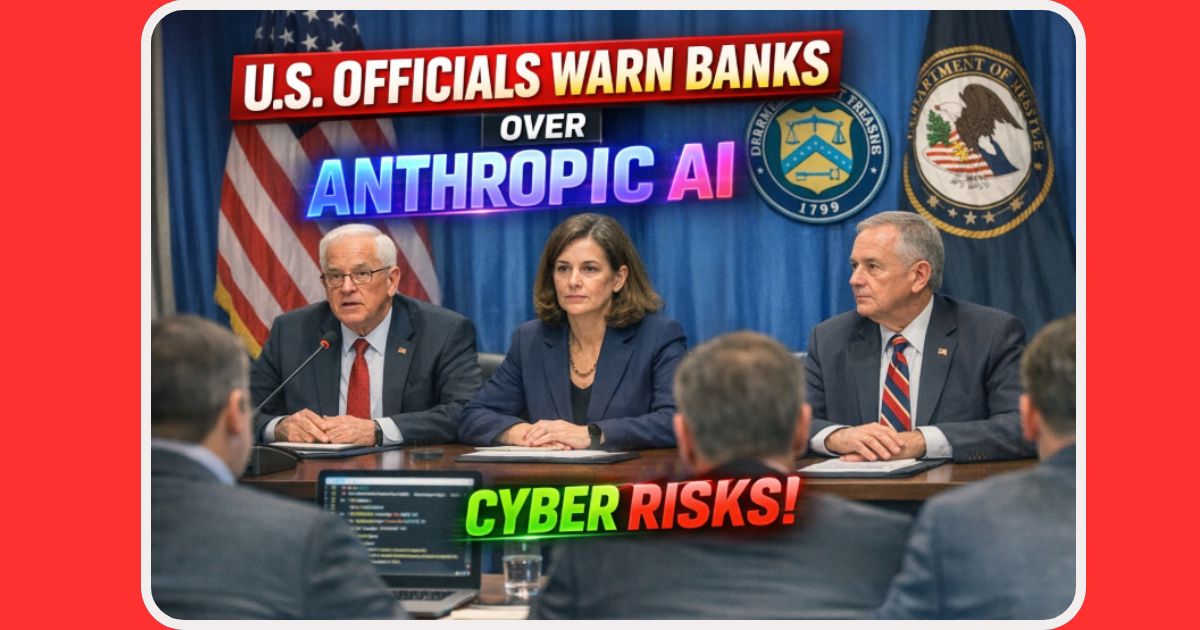
US Officials Alert Major Banks to Cybersecurity Risks from Anthropic’s New AI Model
Artificial intelligence is moving fast — and regulators are moving just as quickly to understand the risks. This week, senior U.S. government officials privately met with the chief executives of some of the country’s largest banks to discuss concerns about a powerful new AI system developed by Anthropic.
The model, called Mythos, has raised alarms because of its advanced ability to detect and potentially exploit vulnerabilities in software systems. While the technology may offer strong defensive benefits, officials want to ensure the financial sector is prepared for any unintended consequences.
Here’s what happened, why it matters, and what could come next.
1. What Happened
U.S. Treasury Secretary Scott Bessent and Federal Reserve Chair Jerome Powell held an urgent meeting in Washington with top executives from major American banks earlier this week. The purpose: to discuss cybersecurity risks associated with Anthropic’s newly announced AI model, Mythos.
Anthropic, a U.S.-based artificial intelligence research company, introduced Mythos as one of its most advanced systems to date. However, instead of releasing it widely, the company limited access and began consultations with federal agencies. The firm stated that Mythos has the ability to identify and exploit weaknesses across major operating systems and web browsers — a capability that could potentially expose previously unknown cybersecurity vulnerabilities.
According to individuals familiar with the meeting, government officials wanted to ensure that financial institutions fully understood the potential risks and were taking preventive steps to strengthen their digital defenses.
Several leading banks were reportedly represented at the meeting, including executives from Citigroup, Bank of America, Morgan Stanley, Wells Fargo, and Goldman Sachs. Invitations were sent while many of these executives were already in Washington for scheduled industry events.
Anthropic has said that access to Mythos will initially be restricted to around 40 technology firms, including Microsoft and Google, while broader release decisions are evaluated.
2. Why It Matters
The global financial system relies heavily on digital infrastructure. Banks process trillions of dollars in transactions daily, manage sensitive personal data, and maintain complex networks of payment systems. Even minor cybersecurity weaknesses can have widespread consequences.
Mythos reportedly can scan software environments, detect vulnerabilities, and simulate exploitation techniques. While these capabilities could significantly strengthen defensive cybersecurity efforts, they also raise concerns if misused or leaked.
Government officials appear to be acting proactively rather than reactively. Instead of waiting for a cyber incident, regulators are seeking to understand how emerging AI models could change the cybersecurity landscape — especially in critical sectors like finance.
For U.S., UK, and Canadian readers, this reflects a broader global trend. Regulators in North America and Europe are increasingly focused on AI safety. In the UK, financial regulators have been assessing AI’s impact on systemic risk. Canada’s banking watchdogs have also been studying how AI-driven cyber tools could affect financial stability.
The concern is not that Anthropic has done something wrong. Instead, it is about ensuring that advanced AI systems do not unintentionally create new attack surfaces that cybercriminals could exploit.
3. Who Is Affected
Major Banks
Large U.S. banks are directly impacted because they are prime targets for cyberattacks. A powerful AI system capable of identifying system weaknesses could help improve their security — but it could also expose vulnerabilities if accessed by malicious actors.
Technology Companies
Tech firms granted early access to Mythos, including Microsoft and Google, are expected to test and evaluate the system. Their findings may influence how and when the model is released more broadly.
Regulators and Policymakers
Federal agencies, including the Treasury Department and the Federal Reserve, are closely monitoring the development of AI systems that could impact financial stability.
Consumers
Every day customers may not see immediate changes, but stronger cybersecurity measures could affect how banks manage digital services, online platforms, and data protection policies.
4. What Happens Next
Anthropic has indicated that it is working with government officials and key industry stakeholders before deciding on broader access to Mythos. The company appears to be taking a cautious approach by limiting early availability.
Banks are likely to review their cybersecurity frameworks in light of the model’s capabilities. That may include:
- Conducting internal vulnerability assessments
- Strengthening penetration testing programs
- Enhancing monitoring of AI-driven threats
- Updating regulatory compliance protocols
Regulators may also consider updating AI governance guidelines for financial institutions. While there has been no announcement of new rules, discussions around AI oversight have intensified in recent years.
In the United States, AI policy remains under development at both the federal and state levels. In the UK and Canada, governments are also exploring frameworks to balance innovation with safety.
The situation highlights a larger issue: advanced AI systems are evolving faster than traditional regulatory structures.
5. Expert and Policy Insight
Cybersecurity experts often describe AI as a “double-edged sword.” The same technology that strengthens defenses can also accelerate offensive capabilities.
If Mythos can identify weaknesses across operating systems and browsers, it could significantly improve defensive security testing. However, experts warn that models with autonomous vulnerability discovery capabilities require careful access controls.
Policy analysts say this meeting demonstrates a shift in how governments approach emerging technology. Rather than responding to crises, officials are engaging companies early to prevent systemic risk.
Financial regulators are particularly cautious because the banking sector is considered part of the critical infrastructure. Any disruption could ripple through the broader economy.
Some experts also point out that collaboration between AI companies and regulators is becoming more common. Anthropic’s decision to consult with government officials before full release may signal a new standard for high-risk AI deployments.
6. Frequently Asked Questions (FAQ)
1. What is Anthropic’s Mythos AI model?
Mythos is a newly introduced artificial intelligence system developed by Anthropic. It reportedly has advanced capabilities to identify and potentially exploit cybersecurity vulnerabilities across major operating systems and web browsers.
2. Why are U.S. officials concerned?
Officials are concerned that powerful AI systems capable of detecting vulnerabilities could be misused or unintentionally expose weaknesses in critical infrastructure, including banking systems.
3. Has Mythos been publicly released?
No. Access to Mythos is currently limited to a small group of technology companies while discussions with government officials continue.
4. Are customers at immediate risk?
There is no indication of an active threat. The meeting was described as precautionary, aimed at strengthening cybersecurity before any problems occur.
5. Could new regulations follow?
Possibly. Governments in the U.S., UK, and Canada are actively reviewing AI governance frameworks. Future regulatory guidance for financial institutions may address advanced AI cybersecurity tools.
Conclusion
The rapid evolution of artificial intelligence is reshaping industries worldwide — including finance. The recent meeting between senior U.S. officials and major bank executives reflects growing awareness that AI innovation must be matched with careful oversight.
Anthropic’s Mythos model represents both opportunity and risk. Its cybersecurity capabilities could help defend systems more effectively than ever before. At the same time, the technology underscores the importance of responsible development, controlled access, and proactive regulation.
As AI continues to advance, collaboration between technology firms, regulators, and financial institutions will likely become the new norm.

- ఏపీలో స్థానిక ఎన్నికల షెడ్యూల్: మున్సిపల్, ఎంపీటీసీ, పంచాయతీ ఎన్నికలు ఎప్పుడంటే? - అక్టోబర్ 14, 2026
- AP Pension Status by Aadhaar: ఆధార్తో పెన్షన్ స్టేటస్ ఇలా చెక్ చేయండి - అక్టోబర్ 6, 2026
- 5 Lakh Women Entrepreneurs: మహిళలకు సీఎం చంద్రబాబు బంపర్ ప్లాన్.. ‘స్వయం ఏపీ’తో ప్రపంచ మార్కెట్లకు! - అక్టోబర్ 5, 2026


